
How to Develop Sovereign AI : Imagine a future where India doesn’t just use AI — it owns and shapes its own intelligence, tailored to its 1.4 billion people, 22 official languages, and unique cultural realities. That’s the power of Sovereign AI, also known as country-specific or desh-specific AI. In simple terms, Sovereign AI means a nation builds, trains, and runs its artificial intelligence systems using its own data, computing power, talent, and infrastructure — without depending on foreign companies or clouds for the most critical parts.
This isn’t just tech talk. NVIDIA’s CEO Jensen Huang popularized the idea because every country needs to “produce its own intelligence” to stay secure, competitive, and innovative. For India, it’s about turning AI into a tool for self-reliance rather than a new form of digital dependence. If you’re a policymaker, startup founder, developer, or even a curious global observer from the USA wondering why India’s AI push matters to the world economy, this guide breaks it down practically. You’ll walk away with real, actionable insights — not hype — on how India can (and is already starting to) develop Sovereign AI step by step.
By the end, you’ll understand the why, the how, and the real-world hurdles, plus practical ways stakeholders can contribute. Let’s dive in like we’re sitting across the table, exploring this together.
Also Read : What Is Physical AI and How It Is Used in Real-World Robots in 2026
What Sovereign AI Really Means and Why It’s Different from Regular AI
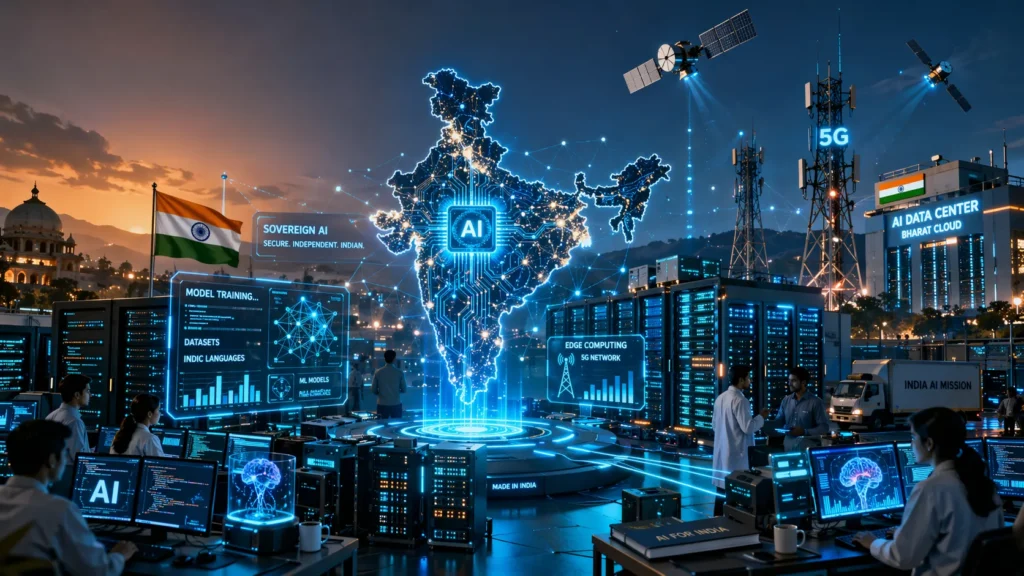
Sovereign AI goes far beyond downloading an API from OpenAI or Google and calling it “Indian AI.” It’s about full control over the entire stack: the massive GPUs that train models, the datasets that teach them, the algorithms customized for local needs, and the secure infrastructure that keeps everything running inside the country’s borders. Think of it as building your own AI factory instead of renting space in someone else’s.
Why does this matter? In a world where AI influences everything from healthcare decisions to national security, relying on foreign systems risks data leaks, biased outputs that don’t understand Indian contexts, or sudden policy changes from abroad cutting off access. For India, Sovereign AI ensures models speak Hindi, Tamil, or Bengali fluently, respect local laws like the Digital Personal Data Protection (DPDP) Act, and solve Bharat-specific problems — like helping farmers predict crop yields in diverse climates or assisting doctors in rural areas with limited connectivity.
This approach creates jobs, protects privacy, and builds long-term economic strength. It’s not isolationism; it’s smart interdependence. India can still collaborate globally while owning the core capabilities that define its future. And for USA audiences, this creates new partnership opportunities — American tech can supply tools, while India offers massive market scale and talent.
Why India Needs Sovereign AI More Than Ever in 2026
India stands at a crossroads. With one of the world’s largest digital populations and a booming startup ecosystem, the country generates enormous data every day. But without Sovereign AI, most of that data flows to foreign servers, and insights return in ways that don’t fully fit Indian realities. Sovereign AI flips this script, turning data into a national asset for growth.
Economically, it drives self-reliance. Imagine AI-powered tools for MSMEs (micro, small, and medium enterprises) that mirror UPI’s success — cheap, scalable, and made in India. Strategically, it reduces risks in sensitive areas like defense, governance, and healthcare. Culturally, it ensures AI respects India’s diversity instead of pushing one-size-fits-all global models that ignore local languages or values.
Global trends make this urgent too. Export controls on advanced chips and rising data sovereignty laws worldwide show that nations ignoring this will fall behind. India, already hosting the India AI Impact Summit 2026, is positioning itself as a leader for the Global South. By building Sovereign AI, India doesn’t just catch up — it leapfrogs to define AI that’s inclusive, ethical, and affordable. The payoff? Stronger national security, more jobs in AI, and a bigger slice of the global AI economy projected to hit trillions.
India’s Current AI Landscape: Impressive Progress with Clear Gaps
As of 2026, India isn’t starting from scratch. The IndiaAI Mission, launched with a ₹10,372 crore outlay, has already delivered tangible results. Over 38,000 GPUs are now available through public-private partnerships at subsidized rates — around ₹65 per hour — letting startups train models without breaking the bank. Companies like Sarvam AI have released powerful models (30 billion and even 105 billion parameters) using mixture-of-experts architecture, optimized for Indian languages and enterprise use. BharatGen, backed by IIT Bombay, supports 22 languages with multilingual capabilities tailored for local needs.
Other players like Fractal Analytics, Tech Mahindra, Gnani.ai, and more are building domain-specific models for healthcare, education, and agriculture. The mission’s AI Kosh provides secure access to Indian datasets, while skilling programs reach over 100 colleges. Data centers have grown from 375 MW in 2020 to 1,500 MW by 2025, and IndiaAI Mission 2.0 is pushing further into R&D, chip design, and MSME adoption.
Yet gaps remain. High-quality, structured data in regional languages is still scarce. Talent often migrates to Silicon Valley. Domestic chip manufacturing and energy-efficient compute lag behind global leaders. These aren’t deal-breakers — they’re solvable with focused effort. The foundation is solid; now it’s time to build the full house.
Key Pillars for Developing Sovereign AI in India

Any successful Sovereign AI strategy rests on five interconnected pillars. Let’s unpack them one by one so you see exactly how they fit together.
First, compute infrastructure. Training modern AI requires thousands of high-end GPUs or equivalent accelerators. India is scaling shared national compute platforms through the IndiaAI Mission, but true sovereignty means more domestic data centers powered by clean energy. This pillar prevents reliance on foreign clouds for sensitive workloads and lowers costs for local developers.
Second, sovereign datasets. AI is only as good as its training data. India must curate massive, high-quality datasets in all major languages while complying with DPDP rules. This includes government data, anonymized citizen records, and contributions from public-private partnerships. Without this, models will always carry foreign biases.
Third, talent and skilling. India has millions of engineers, but specialized AI researchers are fewer. Expanding university programs, offering incentives to retain talent, and creating applied AI labs will build the workforce. Public skilling initiatives already underway are a great start.
Fourth, indigenous model development. This means creating foundation models from scratch or fine-tuning open-source ones on Indian data. Focus on efficiency — smaller, faster models that run on edge devices for rural India, not just massive frontier systems.
Fifth, enabling ecosystem and regulation. Strong policies, ethical guidelines, funding for startups, and public-private collaboration tie everything together. IndiaAI Mission 2.0’s UPI-style playbook for MSMEs shows how this can scale adoption rapidly.
Each pillar reinforces the others. Invest in compute without data, and you get inefficient models. Build talent without infrastructure, and they leave for better opportunities abroad.
How to Develop Sovereign AI (Step-by-Step Practical Guide)
Developing Sovereign AI isn’t a single project — it’s a coordinated national effort. Here’s a realistic, phased roadmap you can follow or advocate for.
Step 1: Establish a clear national strategy and governance. Start by updating the IndiaAI Mission with measurable goals for 2030 — like training X trillion tokens on Indian data or achieving Y% domestic compute utilization. Create a dedicated Sovereign AI task force involving MeitY, NITI Aayog, industry, and academia. This ensures alignment across ministries and prevents fragmented efforts.
Step 2: Build and secure compute infrastructure aggressively. Expand beyond current GPU allocations by incentivizing private data centers with long-term tax breaks. Link this to the Semiconductor Mission for indigenous chip design. Prioritize energy-efficient setups using renewable sources to handle AI’s massive power demands. Aim for a national AI cloud that offers subsidized access to researchers and startups while keeping critical data onshore.
Step 3: Curate sovereign datasets at scale. Launch nationwide data collection drives focused on quality over quantity. Use AI Kosh as a secure repository. Partner with states, universities, and companies to generate synthetic data where real data is limited. Enforce strict privacy standards so citizens trust the system. This step alone can give Indian models a unique edge in understanding local contexts.
Step 4: Accelerate talent development and R&D. Scale skilling programs to produce 100,000 AI-ready professionals annually. Fund university-industry research centers and offer grants for returning talent. Encourage open collaboration while protecting IP. Focus on applied research — models that solve real problems in farming, healthcare, or governance rather than chasing abstract benchmarks.
Step 5: Develop and deploy indigenous models iteratively. Begin with smaller, domain-specific models (like those already emerging from Sarvam and BharatGen) and scale to larger foundation models. Test them rigorously in pilot projects across sectors. Make APIs and tools freely available to MSMEs so adoption spreads quickly, just like UPI did for payments.
Step 6: Foster ecosystem growth and responsible deployment. Provide seed funding, incubation, and regulatory sandboxes for AI startups. Integrate Sovereign AI into Digital Public Infrastructure for seamless government services. Monitor ethics and bias continuously. Measure success not just by model size but by real impact — jobs created, problems solved, and citizen benefits delivered.
Follow these steps with consistent funding and cross-sector coordination, and India can achieve meaningful sovereignty within 3–5 years.
Real-World Challenges and Practical Ways to Overcome Them
No roadmap is complete without honest talk about obstacles. One big challenge is compute and hardware dependency. Global chip shortages and export rules make it expensive. Solution? Double down on design strengths — India already excels at chip architecture. Invest in alternative accelerators and international partnerships that transfer technology without lock-in.
Data quality and scarcity pose another hurdle. Indian languages lack the web-scale content English enjoys. Overcome this by investing in curation projects, synthetic data generation, and crowdsourced contributions. Public incentives for data sharing (while protecting privacy) can accelerate progress.
Talent retention is critical. Brain drain to the USA and Europe continues because of better pay and opportunities. Counter it with competitive salaries, exciting national projects, and equity in startups. Create “AI returnee” programs with relocation support.
Energy consumption and infrastructure costs are rising concerns. AI training uses enormous electricity. Address this through green data centers and efficiency-focused model architectures. Finally, regulatory speed matters — overly strict rules can slow innovation. Balance governance with agility via sandboxes and stakeholder input.
These challenges are real but surmountable. India has overcome bigger ones before, from building Aadhaar to launching UPI. Focused execution is the key.
Lessons from Other Countries’ Sovereign AI Journeys
Looking abroad provides valuable blueprints without copying blindly. China took a state-heavy approach, investing massively post-sanctions to build end-to-end stacks in chips and models. The result? Rapid self-reliance, though at the cost of some international collaboration.
The UAE shows agility works. With sovereign wealth and smart partnerships (like with Microsoft and G42), it built Arabic-focused models and a sovereign cloud, becoming a regional AI hub despite limited population. France emphasizes strategic autonomy through national clusters, regulation, and heavy investment in European values-aligned AI.
India’s path should blend the best: public leadership like China’s mission, partnership savvy like the UAE’s, and ethical focus like France’s. The difference? India’s democratic scale and digital public goods experience give it a unique advantage for inclusive, bottom-up AI that serves the masses.
How You Can Get Involved — Practical Actions for Everyone
Sovereign AI isn’t just for government. Startups can apply for IndiaAI compute credits and build on existing models like Sarvam or BharatGen. Developers should learn multilingual fine-tuning and contribute to open datasets. Businesses, especially in healthcare and education, can pilot sovereign solutions for compliance and cost savings.
Policymakers: Push for sustained funding in the next budget and faster semiconductor incentives. Academics: Collaborate on domain-specific research. Even individuals can upskill through free government platforms and advocate for ethical AI.
For USA readers partnering with India, this means exciting joint ventures — supplying hardware or expertise while benefiting from India’s market and talent pool. Everyone wins when AI becomes truly sovereign.
The Future Outlook: What Success Looks Like for India
Picture 2030: Sovereign AI powers personalized education in every village, real-time crop advice for farmers, and efficient governance that reaches the last mile. India exports affordable, multilingual AI tools to the Global South. The economy gains millions of new jobs, and strategic autonomy strengthens national resilience.
This future is within reach. With IndiaAI Mission 2.0 emphasizing diffusion to MSMEs and full-stack capabilities (compute, chips, models, energy), momentum is building. The India AI Impact Summit 2026 will showcase early wins — prototypes, deployments, and global partnerships.
Conclusion: Your Role in India’s Sovereign AI Story
Developing Sovereign AI for India isn’t a distant dream — it’s a practical, phased journey already underway. By focusing on compute, data, talent, models, and ecosystem, India can create country-specific AI that’s secure, relevant, and transformative.
The key takeaway? Start small but think national. Every GPU allocated, every dataset curated, and every skilled engineer retained moves the needle. Whether you’re building the next model, shaping policy, or simply learning about AI’s global impact, your actions matter.
India has the talent, the data, and the vision. Now is the time to execute with focus and collaboration. Sovereign AI won’t just change India — it will redefine how nations harness intelligence for their people. The foundation is laid. The next chapter depends on all of us taking practical steps today.









Mahi
Hello friends! My name is Mahi and I am the Founder & Writer of Studynumberone.Net. I write content related to Ai, Technology, Make Money, and Education. Hope you like my Articles!
Ghost GF Couple AI Photo Editing Prompts | ChatGPT Photo Prompts
Ghost GF Couple AI Photo Editing Prompts : Friends, in today’s article, I am going to share some…
Read MoreInstagram Profile Followers Poster AI Photo Prompts | Social Media Profile Poster Prompts
Instagram Profile Followers Poster AI Photo Prompts : Nowadays, you must have noticed Instagram Followers Milestone posters appearing…
Read MoreAesthetic Name DP AI Photo Editing Prompts | ChatGPT Prompts
Aesthetic Name DP AI Photo Editing Prompts – Nowadays, many people are using ChatGPT and AI tools to…
Read MoreHow to Make Money with AI No Experience 2026: The Complete Beginner’s Guide to Turning Free Tools into Real Income Streams
How to Make Money with AI No Experience : Hey there. If you’re reading this right now in…
Read More