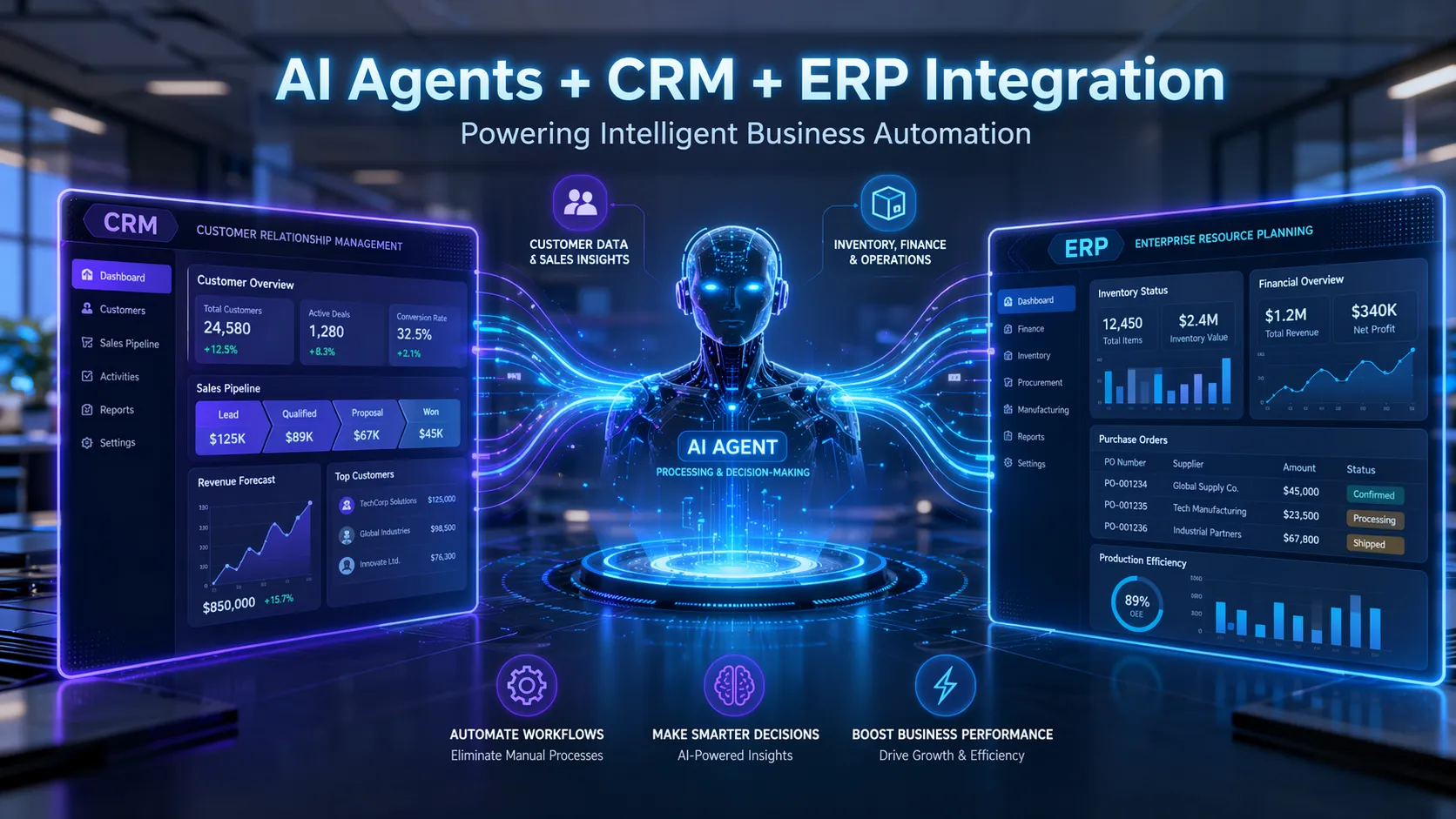
How to Integrate AI Agents : If you run a business in the United States today—whether it’s a mid-sized manufacturing firm in the Midwest or a fast-growing SaaS company on the West Coast—you’ve probably heard the buzz around AI agents. But here’s the truth most consultants won’t tell you upfront: the real game-changer isn’t just slapping another chatbot on your website. It’s teaching autonomous AI agents to work inside the tools you already pay for every month—your CRM like Salesforce or HubSpot, and your ERP like SAP, Oracle, or NetSuite.
This integration turns static data into action. An agent doesn’t just analyze a lead in your CRM; it can update the deal stage, schedule a follow-up call, pull inventory from your ERP, and even draft a personalized proposal—all while you’re in a meeting. Businesses that get this right are seeing 30-50% faster response times, fewer manual errors, and happier teams who finally stop copying data between systems.
In this guide, I’m walking you through exactly how to make it happen. No hype, no vague theory—just the step-by-step playbook that actually works in real American companies right now. By the end, you’ll know how to evaluate your current setup, choose the right tools, avoid the expensive mistakes, and measure real ROI. Let’s get into it.
What Are AI Agents and Why Is “Agentic AI” Different from Regular AI?
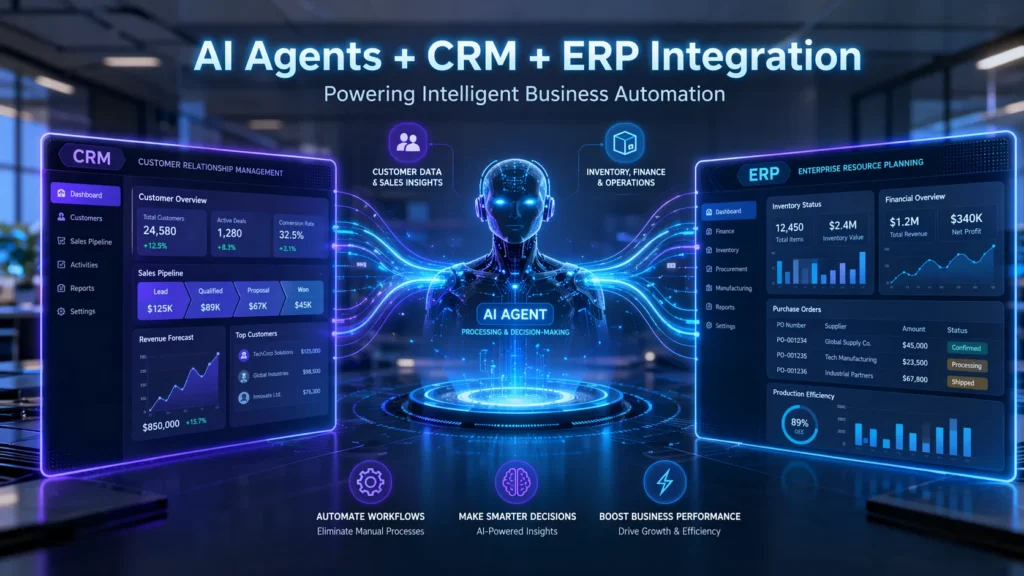
First, let’s clear up the terminology so you’re not lost in the marketing noise. Traditional AI—think predictive analytics in your CRM or basic chatbots—reacts to what you ask. It gives you insights or answers but stops there. You still have to take the next step.
Agentic AI changes that completely. These are autonomous systems that can plan, reason, use tools, and execute multi-step tasks on their own. An AI agent might notice a low-stock alert in your ERP, check supplier prices across three systems, negotiate via email (within rules you set), and place the order—without anyone clicking a button.
The “agentic” part refers to goal-oriented behavior. The agent has a clear objective (“keep inventory above 95% without exceeding budget”), memory of past actions, and the ability to loop through tools like APIs, databases, or even other agents. In 2026, this isn’t science fiction. Gartner already projects that 40% of enterprise applications will include task-specific AI agents by the end of the year.
For U.S. businesses, this matters because labor costs are high and competition is fierce. Agentic AI doesn’t replace your people—it multiplies what they can do. Your sales rep spends time closing deals instead of updating records. Your operations manager focuses on strategy instead of chasing purchase orders.
Also Read : What Is Physical AI and How It Is Used in Real-World Robots in 2026
Why Integrating AI Agents with Your Existing CRM and ERP Makes Business Sense
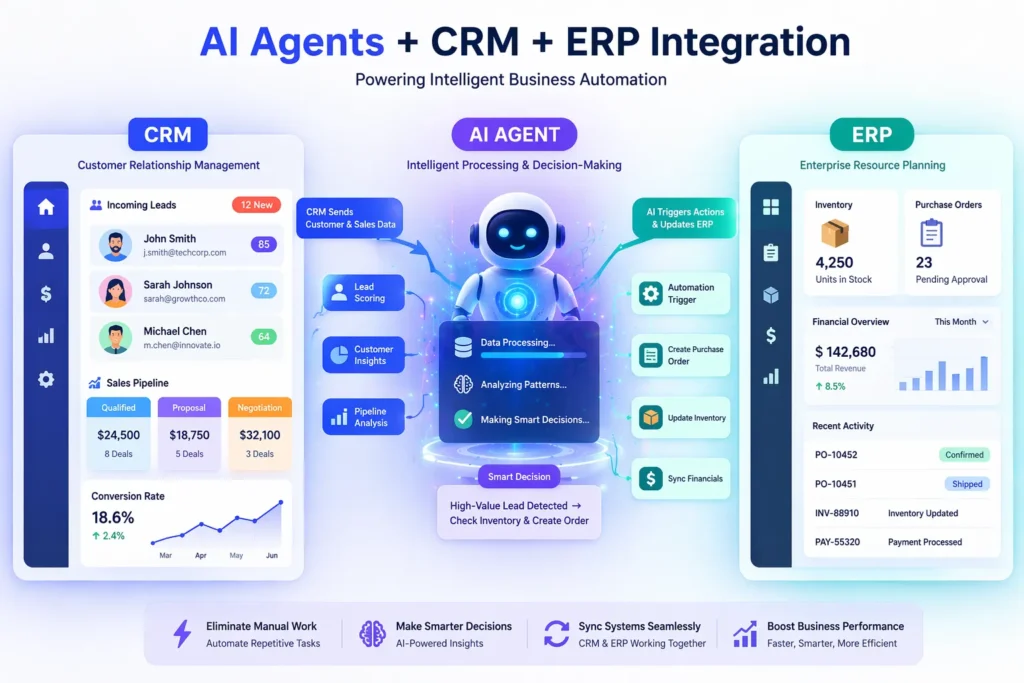
Most companies already have years of clean (or mostly clean) data sitting in Salesforce, Dynamics 365, or SAP. That data is gold for agents. When you connect an agent directly, it stops guessing and starts acting on real-time, accurate information.
Think about the daily pain points. Sales teams complain that CRM data is outdated because reps hate data entry. Operations teams lose hours reconciling ERP numbers with actual shipments. Customer service reps juggle three tabs trying to answer a simple question. An integrated AI agent fixes all three at once by reading from and writing back to the same systems your team already trusts.
The financial upside is huge too. Early adopters report cutting administrative work by up to 60% in sales and supply-chain processes. In the U.S., where compliance with CCPA, SOC 2, and industry rules is non-negotiable, agents can even help by automatically flagging data-privacy issues before they become problems. You keep full control, set strict guardrails, and still get the speed.
Bottom line: integration isn’t optional anymore. It’s how forward-thinking companies turn their existing software investments into competitive superpowers instead of expensive legacy systems.
Also Read : How to Build Multi-Agent AI Systems Using Open Source Tools Like CrewAI and AutoGen in 2026
How to Integrate AI Agents with Your CRM and ERP Systems
Start simple. Don’t try to automate the entire company on day one. Begin by picking one high-pain, high-value workflow.
Step 1: Audit your current systems and data. Map every field the agent will need—lead status in CRM, inventory levels in ERP, customer contact details. Check data quality. Agents amplify bad data, so clean it first. Most companies spend two to four weeks here and thank themselves later.
Step 2: Choose your integration approach. You have three practical paths in 2026. Native platform agents (like Salesforce Agentforce or SAP Joule) are fastest if you’re already deep in one ecosystem. They connect out of the box but can feel limiting if you use multiple systems. Low-code/no-code platforms (Make.com, n8n, or Zapier with AI extensions) let non-developers build agents quickly. For maximum power and customization, use open frameworks like CrewAI or LangGraph connected via secure APIs.
Step 3: Set up secure, bidirectional connections. Use official APIs or middleware that supports OAuth, rate limiting, and audit logs. Never hard-code credentials. Modern tools let agents read and write safely while respecting your permission model. Test with a sandbox environment first—U.S. companies especially appreciate this because it keeps production data untouched.
Step 4: Define the agent’s goals, tools, and guardrails. Write clear instructions: “If inventory drops below 20 units and the customer order is over $5,000, check three approved suppliers and place the order only if price is within 5% of target.” Add memory so the agent remembers previous decisions. Include human-in-the-loop approval for anything that touches money or customer data.
Step 5: Test, monitor, and scale. Run parallel pilots for two weeks. Measure before-and-after metrics like time saved or error rate. Use built-in observability dashboards so you can see exactly what the agent did and why. Once it’s stable, roll it out department by department.
This five-step process typically takes 4–12 weeks depending on complexity, and the ROI starts showing in the first month.
Real-World Practical Use Cases of Agentic AI in CRM and ERP
Let’s make this concrete with examples that actually happen in American businesses today.
Sales and CRM Automation
An agent monitors new leads in Salesforce. It scores them using your historical win data, enriches contact info from public sources (within compliance rules), drafts a personalized outreach email, schedules a calendar invite if the lead replies, and updates the deal stage automatically. One Midwest distributor cut their lead-to-opportunity time by 45% this way. The sales team loves it because they close more deals instead of doing admin work.
Supply Chain and ERP Operations
In your ERP, an agent watches inventory levels across warehouses. When stock runs low, it cross-references supplier lead times, current freight rates, and open purchase orders. It generates a PO, sends it for approval via Slack or email, and updates the ERP once approved. During peak seasons, this prevents stockouts that used to cost U.S. manufacturers thousands in lost sales.
Customer Support and Service
A support agent in your CRM pulls the full customer history from both CRM and ERP. When a ticket comes in, it suggests exact solutions, checks inventory for replacements, issues refunds within policy limits, and closes the case. Companies using this have scaled support capacity dramatically without hiring more agents.
Finance and Compliance Workflows
Agents reconcile invoices between ERP and CRM, flag discrepancies, and prepare audit-ready reports. They even draft expense reports from credit-card data and route them for approval. This is especially valuable for U.S. companies facing stricter financial regulations.
These aren’t theoretical. Real teams are running them right now and seeing measurable gains in efficiency and accuracy.
Common Challenges (and How Smart Teams Overcome Them)
No integration is perfect on the first try. Here are the biggest hurdles I see and exactly how to handle them.
Data silos and quality issues top the list. Agents need consistent formats across systems. The fix is simple but non-negotiable: establish a single source of truth and run regular data-cleaning routines before connecting agents. Many companies use middleware that normalizes data on the fly.
Security and compliance fears keep executives up at night—and for good reason in the U.S. Solve this with zero-trust architecture, granular permissions, and full audit trails. Choose platforms that log every action the agent takes and let you revoke access instantly. Never give agents more rights than a careful human employee would have.
Legacy systems without modern APIs are another headache. Middleware layers or robotic process automation (RPA) bridges work well here. They act as translators so your 15-year-old ERP can still talk to modern agents.
Finally, change management matters. Your team might worry about job security. Be transparent: agents handle the boring stuff so people can focus on creative, high-value work. Train everyone early and celebrate quick wins.
Tools and Technologies Worth Considering in 2026
You don’t need to build everything from scratch. Here are battle-tested options:
- Native platforms: Salesforce Agentforce for CRM-heavy companies, SAP Joule for ERP-centric operations. They integrate fastest but work best inside their own ecosystem.
- Orchestration frameworks: CrewAI, AutoGen, or LangGraph give you full control and let agents coordinate multiple tools.
- Low-code connectors: Make.com, n8n, or unified API platforms like Unified.to let you connect agents to 100+ systems without deep coding.
- Enterprise-ready options: IBM watsonx Orchestrate or Microsoft Copilot Studio for larger organizations that need heavy governance.
Pick based on your stack, team skills, and budget. Start with whatever gets you a working prototype in under two weeks.
Measuring Success and Planning for the Future
Track the right metrics from day one: time saved per process, error reduction percentage, cost per transaction, and employee satisfaction scores. Tie everything back to revenue impact or cost savings so leadership stays bought in.
Looking ahead, agentic AI is moving toward multi-agent teams—specialized agents that collaborate like a digital workforce. By 2027, expect tighter integration with voice, vision, and real-time data streams. The companies winning will be the ones that started integrating today.
Ready to Get Started?
Integrating AI agents with your CRM and ERP isn’t about chasing the latest trend. It’s about finally making your existing software investments work harder for you. Start small, stay disciplined about security and data quality, and focus on workflows that actually hurt your team right now.
You’ll see results faster than you expect—and your competitors who are still talking about “AI strategy” instead of doing it will notice. If you’re a U.S. business leader ready to move from pilot projects to production agents, the playbook above gives you everything you need.
Take the first step this week: pick one painful workflow, audit your data, and build a simple prototype. The tools are ready. Your team is waiting. The competitive edge is yours to claim.









Mahi
Hello friends! My name is Mahi and I am the Founder & Writer of Studynumberone.Net. I write content related to Ai, Technology, Make Money, and Education. Hope you like my Articles!
Ghost GF Couple AI Photo Editing Prompts | ChatGPT Photo Prompts
Ghost GF Couple AI Photo Editing Prompts : Friends, in today’s article, I am going to share some…
Read MoreInstagram Profile Followers Poster AI Photo Prompts | Social Media Profile Poster Prompts
Instagram Profile Followers Poster AI Photo Prompts : Nowadays, you must have noticed Instagram Followers Milestone posters appearing…
Read MoreAesthetic Name DP AI Photo Editing Prompts | ChatGPT Prompts
Aesthetic Name DP AI Photo Editing Prompts – Nowadays, many people are using ChatGPT and AI tools to…
Read MoreHow to Make Money with AI No Experience 2026: The Complete Beginner’s Guide to Turning Free Tools into Real Income Streams
How to Make Money with AI No Experience : Hey there. If you’re reading this right now in…
Read More