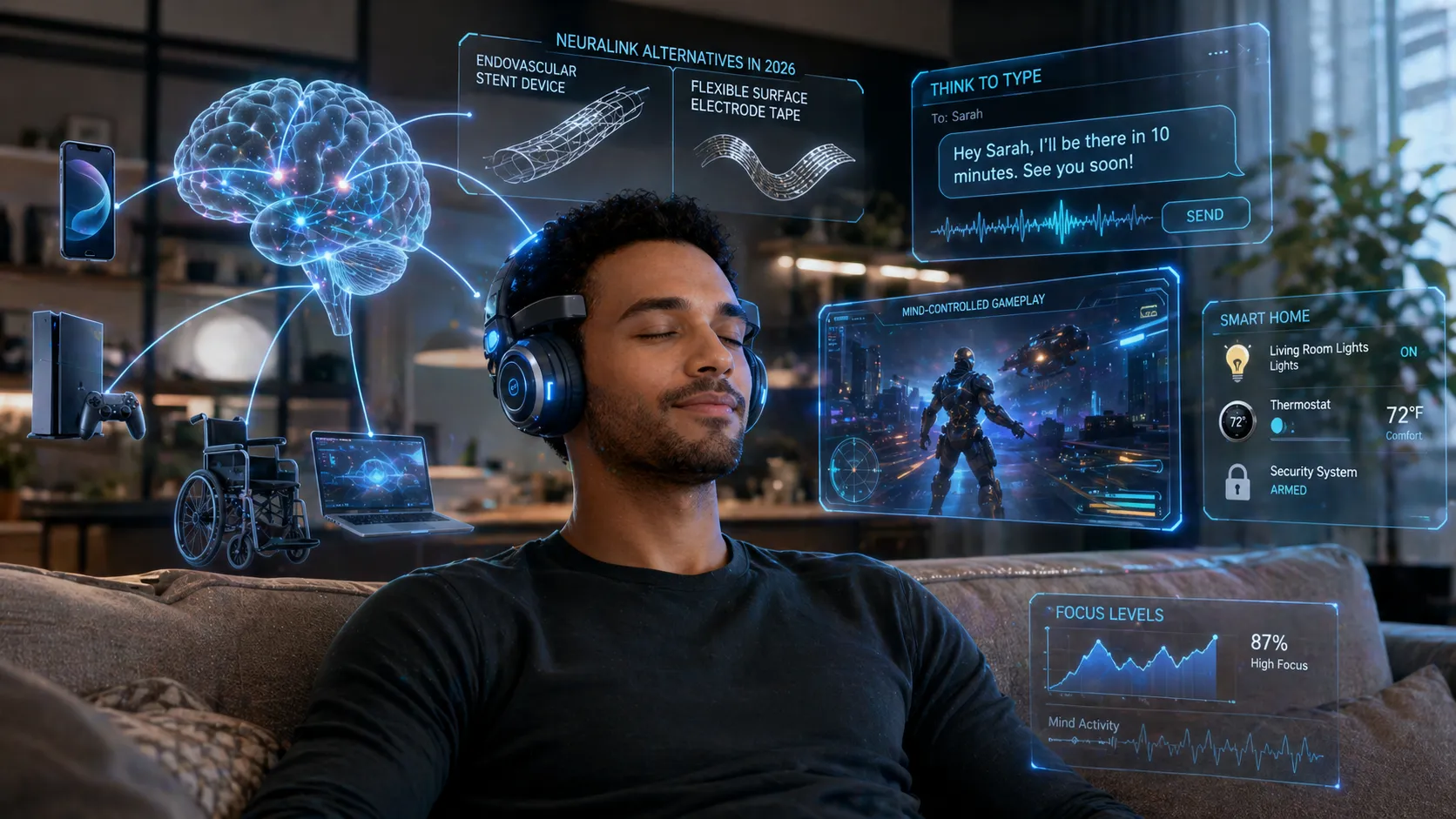
Brain-Computer Interface : Hey folks, let me paint a picture for you. Picture sitting on your couch after a long day, wanting to reply to a quick text or fire up your favorite game, but without grabbing your phone or controller. You just think about it, and it happens. Sounds like something straight out of a sci-fi movie, right? Well, in 2026, this is getting closer to reality thanks to Brain-Computer Interfaces (BCI).
While Neuralink often steals the spotlight with its high-tech brain implants, there are plenty of practical Neuralink alternatives already making a difference in everyday life. These range from safer, minimally invasive options to completely non-invasive headsets you can wear like regular headphones.
I’ve spent time digging into what’s actually working today for regular people — especially those dealing with mobility challenges, gamers looking for an edge, or anyone wanting better focus. In this post, I’ll walk you through the real-world use cases, explain things simply like we’re chatting over coffee, and share practical tips so you come away with knowledge you can actually use. No hype, just honest insights for my American readers who want tech that improves daily life without unnecessary risks.
Understanding Brain-Computer Interfaces (BCI)
Let’s start from square one. Your brain is constantly firing electrical signals whenever you think, plan a movement, or focus on something. A Brain-Computer Interface picks up those signals and turns them into actions on a computer, phone, or even a prosthetic limb. It’s basically a translator between your mind and machines.
There are a couple of main approaches. Invasive BCIs involve surgery to place tiny electrodes directly on or inside the brain tissue. This gives super clear, high-quality signals, which is why companies like Neuralink push it hard. But surgery means risks — infection, recovery time, and questions about how well the signals hold up over years.
On the flip side, non-invasive BCIs use sensors on the outside of your head, usually through EEG (electroencephalography) technology. You wear a headset or earbuds, and it reads brain waves without any cutting. It’s safer and way more accessible for daily use, though the signals can be a bit noisier because they have to travel through your skull and skin. Modern AI helps clean that up and make it reliable.
Hybrid systems are also popping up, mixing brain signals with eye tracking or subtle muscle movements for smoother control. As of 2026, advances in machine learning mean even non-invasive setups feel more natural. You might imagine moving your hand to “grab” something in VR, or just focus your attention to select an option on screen.
Why should everyday Americans care? Think about it — keyboards, touchscreens, and voice commands have limits. If your hands are full cooking dinner, driving, or if you have limited mobility from an injury or condition like ALS, BCI opens doors. Early users often talk about feeling more independent and less frustrated. It’s not magic, though. It takes some practice and calibration, but the payoff can be huge for quality of life.
I’ve seen how this tech shifts mindsets. Instead of adapting to the device, the device starts adapting to how your brain naturally works. That’s the real game-changer.
Why Look Beyond Neuralink? Safer and More Practical Neuralink Alternatives
Neuralink has done amazing work showing what’s possible — people controlling cursors, playing games, and browsing with thoughts alone. But its fully invasive threads come with understandable concerns: brain surgery isn’t something most folks line up for, and long-term durability is still being proven.
That’s why so many people (and doctors) are excited about alternatives that balance performance with safety and accessibility. Here are some of the standout options making progress in 2026:
Synchron’s Stentrode is a clever minimally invasive choice. Instead of opening the skull, doctors insert it through a vein in your neck, kind of like placing a stent for your heart. It sits in a blood vessel near the brain’s motor area. Patients with paralysis have used it to text, email, and control devices hands-free. It’s in ongoing trials, including new ones starting in 2026, and feels less risky for many.
Paradromics’ Connexus BCI focuses on high data rates — they’ve hit over 200 bits per second in tests, which is a big deal for things like natural speech restoration. It’s designed for durability and is in early FDA-approved human trials aimed at helping people with severe motor impairments communicate better. They emphasize real patient needs over flashy demos.
Precision Neuroscience offers a flexible, tape-like array placed on the brain’s surface through a small opening. It’s meant to be gentler and even removable if needed, with strong signal quality in early trials.
Blackrock Neurotech’s Utah Array has years of real-world use under its belt. People with tetraplegia use it at home to control computers, type messages (sometimes up to 90 characters per minute), play games, or even operate robotic arms. It’s all about practical independence in daily routines.
For those who want zero surgery, non-invasive leaders like Neurable, Emotiv, Neurosity, and others are delivering consumer-friendly EEG headsets and smart headphones. Neurable has teamed up with gaming brands like HyperX for headsets that track focus during play. Emotiv offers reliable research-grade options that also work for wellness and basic control. These are things you can buy or try today without a doctor’s approval for non-medical uses.
The key difference? Non-invasive options win for comfort and low risk in everyday scenarios, while the minimally invasive ones provide higher precision for medical needs. Most people starting out should explore wearables first — they’re affordable, removable, and improving fast with better AI.
Everyday Use Case 1: Restoring Communication and Independence for People with Paralysis or ALS
One of the most meaningful applications hits close to home for many families: helping people who’ve lost the ability to speak or move due to ALS, stroke, spinal injuries, or similar conditions.
Traditional tools like eye-gaze trackers or sip-and-puff devices work but can be slow and exhausting. With BCI, users imagine specific actions — like moving a cursor or selecting letters — and the system turns those thoughts into text or speech. Synchron users have sent messages to loved ones and controlled smart home features this way. Paradromics and others are pushing toward decoding intended speech more naturally, often teaming up with language AI for faster, more accurate output.
Beyond talking, these systems let people operate wheelchairs, turn on lights, or browse the internet independently. Shared autonomy helps too — the AI handles some details so you don’t have to mentally micromanage every step. Users in trials report feeling more connected to family and in control of their environment again.
In real life, it starts with calibration sessions that feel like simple games. Over time, accuracy improves with practice. Challenges exist, like maintaining good signal quality if you move around, but combining BCI with other inputs (like gaze) makes it more robust for daily use. For American families dealing with caregiving, this can reduce daily burden and restore dignity. At-home systems from companies like Blackrock are designed exactly for that — independent living without constant professional help.
I’ve read stories of people typing emails or chatting online after years of silence. It’s not perfect yet, but the progress feels deeply human.
Everyday Use Case 2: Gaming, VR/AR, and Entertainment Without Hands
Gamers and VR fans are jumping on this early. Non-invasive headsets from Neurable or similar companies let you select items, move characters, or trigger actions just by focusing or imagining movements. No more fumbling with controllers in immersive worlds.
Imagine playing a puzzle game or exploring a virtual environment where you “think” to grab an object or look around. At CES 2026, demos showed non-invasive systems handling complex gameplay with surprising speed and accuracy. Neurable’s work with HyperX even helps track your focus during intense sessions and gives feedback to improve reaction times.
This goes beyond fun. In education or training, students with physical limits can interact fully with simulations. Passive monitoring adjusts difficulty based on your mental state — if you’re zoning out, it might ease up or suggest a break.
Practical advice: Start with affordable EEG headsets that work with open-source software. Short practice sessions help your brain patterns become consistent. For fast-action games, it might not fully replace a mouse yet, but for strategy, narrative, or relaxation experiences, it’s incredibly immersive. As hardware gets better, expect more games built specifically around thought control. For busy professionals or parents, it could mean entertainment during hands-busy moments, like exercising or commuting.
The excitement is real — this tech makes digital worlds feel more personal and accessible.
Everyday Use Case 3: Focus, Productivity, and Mental Wellness Monitoring
A lot of us struggle with distractions, burnout, or figuring out when we’re truly “in the zone.” Non-invasive BCIs shine here by quietly monitoring brain activity and giving real-time insights.
Devices like Neurosity’s Crown or Neurable’s integrated headphones track attention levels, cognitive load, and even fatigue. During work or study, they can suggest optimal times for deep focus or remind you to take a break. Some use neurofeedback — simple games or sounds that train you to strengthen calm, focused brain patterns.
For mental wellness, certain systems pair monitoring with gentle stimulation techniques to help with mood or stress. In workplaces or schools, they could promote better habits without invasive monitoring. Industrial versions already watch for fatigue in high-risk jobs like driving or operating machinery.
To use it practically: Wear a comfortable headset for 20-30 minutes during tasks. Apps show easy dashboards with trends over time. Many users notice they become more aware of their own mental states after a few weeks, leading to smarter scheduling and fewer crashes. Comfort for all-day wear and strong privacy protections are important — choose brands transparent about data handling.
It’s like having a personal coach for your brain, helping busy Americans juggle work, family, and self-care more effectively.
Everyday Use Case 4: Smart Home Control, Accessibility, and Rehabilitation
Turning your home into a thought-powered space is another exciting area. People with limited mobility can switch lights, adjust temperature, play music, or control TVs just by intending the action. These systems integrate with popular smart home setups for seamless living.
In rehab, BCIs provide immediate feedback. Stroke survivors imagine movements while the system stimulates muscles or displays progress, encouraging the brain to rewire itself. Gamified sessions make therapy less boring and more effective, improving long-term results.
For broader accessibility, BCIs help in schools or offices by adapting interfaces to individual needs. Hybrid setups with AI assistance let you give high-level commands while the system handles details, like directing a helper robot.
In daily practice, you do a quick calibration each session. Combining BCI with voice or simple gestures adds reliability. Over months, many users get better at motor imagery, making control feel more intuitive. For families supporting loved ones with disabilities, this means greater freedom and less constant assistance.
Challenges and Practical Considerations for Everyday BCI Adoption
Let’s be real — this tech isn’t flawless yet. Non-invasive systems can pick up interference from movement or sweat. Invasive or minimally invasive options involve medical procedures with their own risks and costs. Battery life, comfort during long wear, and integration with your existing devices are still improving.
Privacy matters a lot. Your brain data is incredibly personal, so look for companies with clear policies and strong encryption. Ethical questions around workplace monitoring or equal access (making sure it’s not just for the wealthy) need ongoing attention.
How to get started smartly? Begin with consumer non-invasive headsets if you’re curious or focused on wellness/gaming. For medical needs, talk to doctors and explore clinical trials. Consistent short practice beats long frustrating sessions. Regulatory bodies like the FDA are moving faster with breakthrough designations, which helps safe devices reach people sooner.
The Future of Everyday BCI
Looking ahead, I expect BCIs to blend into everyday items — glasses, earbuds, even clothing. AI will make setup quicker and personalization better. Bidirectional systems (reading and gently influencing brain activity) could one day help with memory, learning, or mood in safe ways.
Consumer uses in wellness, entertainment, and productivity will likely grow fastest because they’re lower risk. Medical applications will expand too, especially for communication and rehab. Non-invasive tech will probably dominate daily life for most Americans, with more advanced options reserved for those who need them.
My advice? Stay curious but grounded. Try accessible tools, follow real user stories, and think about how this fits your life. Support ethical development and push for broader access.
In the end, Brain-Computer Interfaces — particularly the practical Neuralink alternatives available or advancing right now — are about giving people more control over their days. Whether it’s regaining independence, leveling up in games, staying focused at work, or making home life easier, the benefits feel personal and real.









Mahi
Hello friends! My name is Mahi and I am the Founder & Writer of Studynumberone.Net. I write content related to Ai, Technology, Make Money, and Education. Hope you like my Articles!
How to Deploy Low-Power AI Models on Edge IoT Devices ?
How to Deploy Low-Power AI Models on Edge IoT Devices : In our increasingly connected world, IoT devices…
Read MoreBest Open-Source AI-Native Development Platforms in 2026: How They Fully Automate Software Development with AI
Open-Source AI-Native Development Platforms: Hey there, if you’re a developer, startup founder, or engineering leader in the US…
Read MoreHow to Integrate AI Agents with Existing CRM and ERP Systems: A Practical Guide to Unlocking Agentic AI’s Real-World Power
How to Integrate AI Agents : If you run a business in the United States today—whether it’s a…
Read MoreHow to Develop Sovereign AI (Country-Specific AI) for India in 2026: A Complete Step-by-Step Guide to Building Independent AI Infrastructure, Models, and Ecosystem
How to Develop Sovereign AI : Imagine a future where India doesn’t just use AI — it owns…
Read More